“If Israel does not control the Jewish heartland in Judea and Samaria, peace will be impossible,” Klein said.
By Marc Rod
(December 11, 2025 / Jewish Insider) Members of the House Foreign Affairs Committee and expert witnesses on Wednesday debated the meaning and significance of President Donald Trump’s edict in September that he “will not allow Israel to annex the West Bank,” which came amid a reported effort earlier this year by the Israeli government to assert sovereignty over all or part of the territory.
The at-times contentious hearing focused on “Understanding Judea and Samaria: historical, strategic and political dynamics in U.S.-Israel Relations,” referring to the biblical term for the West Bank preferred by members of the Israeli government and also used by Republicans on the Foreign Affairs Committee.
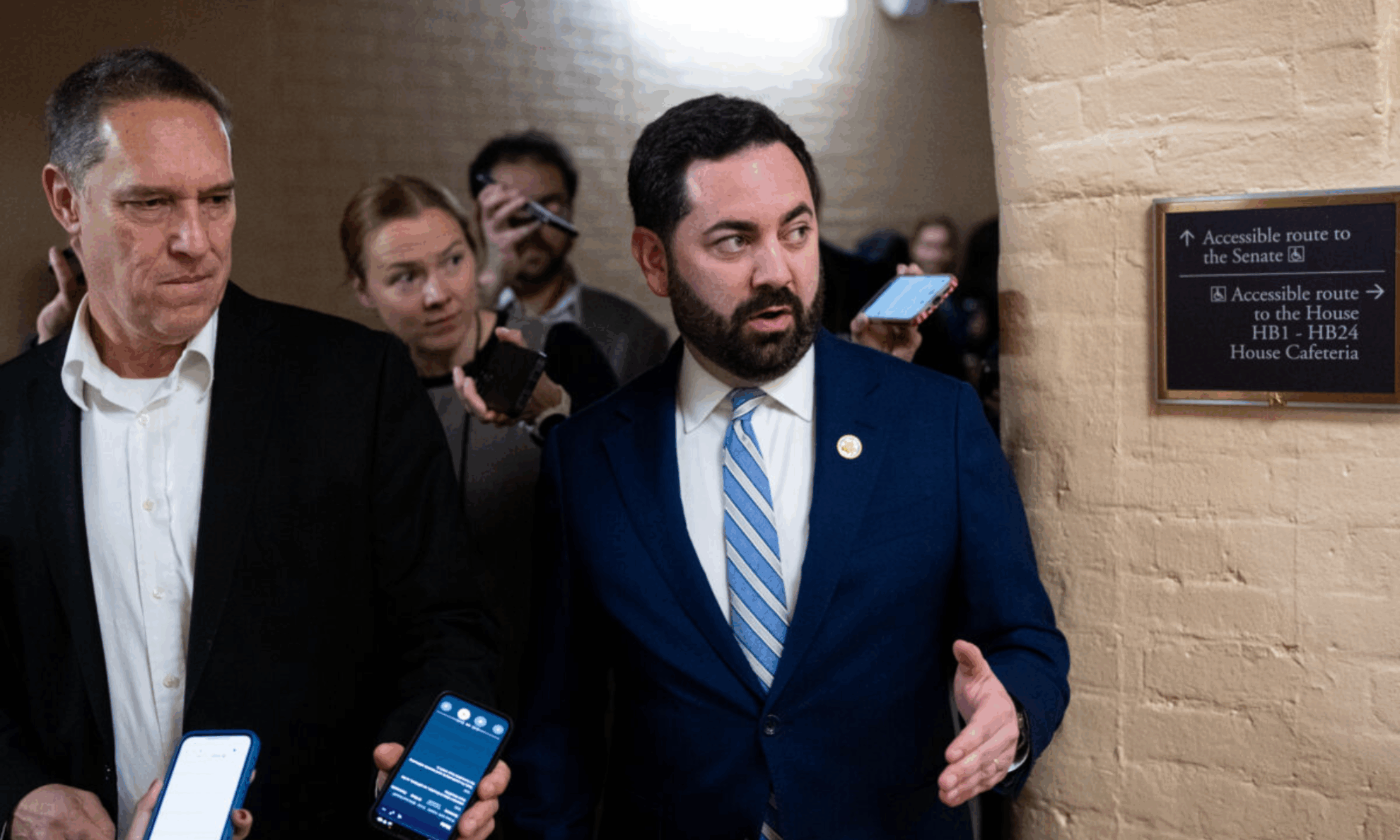
Rep. Mike Lawler (R-NY), the chairman of the Foreign Affairs subcommittee on the Middle East, which hosted the hearing, asserted that Trump was only expressing his opposition to the annexation of territory not currently controlled by Israel.
“When the president is talking about annexing, again, I think it’s important to actually look at the map,” Lawler said. “Sixty percent of the West Bank is under Israeli control.”
Lawler’s comments came in response to a remark from ranking member Rep. Brad Sherman (D-CA) highlighting Trump’s position on the issue.
“While some have argued that you don’t need to annex the West Bank because it’s already part of Israel, clearly that’s not what President Trump had in mind,” Sherman argued.
The back-and-forth set off a spat between the two members, with Sherman shouting a demand to be given additional time to respond to Lawler, and Lawler rebuking him in hushed tones as the hearing continued.
Lawler previously organized a private briefing for committee members with U.S. Ambassador to Israel Mike Huckabee on a similar subject.
Rep. Brad Schneider (D-IL) pressed GOP witnesses over their apparent disagreements with Trump on the issue. Like Lawler, they made the case that Trump’s position had been misrepresented.
Eugene Kontorovich, a senior research fellow at the Heritage Foundation, argued that Trump’s position and the situation have not been “accurately characterized.”
“There have been proposals to extend Israeli civil law to those areas where Jewish communities are, in other words, to incorporate under Israeli law, parts of Judea and Samaria,” Kontorovich said. “President Trump’s plan is consistent with his 2020 vision for peace, where Israel would, in fact, expand Israeli civil jurisdiction specifically to those areas, and it seems his comments were simply a reaffirmation of that, that’s how I understand it.”
Schneider responded: “I think his comments were clear: ‘There will not be annexation,’ was I believe exactly what he said,” to which Kontorovich interjected, “of the West Bank.”
The Vision for Peace plan that Kontorovich referenced would also have created a Palestinian state. Plans announced by Israeli Prime Minister Benjamin Netanyahu at the time to annex Israeli settlements immediately upon the release of that plan were rejected and blocked by Trump in 2020.
Multiple Democrats along with Democratic witness Jon Alterman, the Brzezinski chair in global security and geostrategy at the Center for Strategic and International Studies, raised comparisons between the political and governance situation in the West Bank and eastern Ukraine — noting that ethnically Russian Ukrainians had a voice and vote in the Ukrainian government prior to the Russian invasion, and that they are now disenfranchised under Russian occupation.
Alterman said that allowing annexation would also weaken the U.S.’ argument against Russia’s attempted annexation of parts of Ukraine.
Democratic lawmakers and Alterman also warned that full annexation would create a politically untenable position for Palestinians in the West Bank, where they are disenfranchised under Israeli control or expelled — a situation that could prompt further international outrage — or have voting rights and would have sufficient voting share to fundamentally change the nature of Israel. Alterman added that the status quo breeds Palestinian resentment and opposition from the global community.
“If we’re honest with ourselves, we need to recognize that not only are there competing claims here, but there are competing legitimate claims, and that’s if we just consider what’s clear from the historical record. When we bring in faith values and interests which aren’t universal, the issue becomes even more complicated,” Alterman said. He urged lawmakers to seek solutions that preserve space for peace between the Israelis and Palestinians.
Rep. Darrell Issa (R-CA) floated the question of whether the U.S. should, instead of a full separation of Israel and a Palestinian state under a two-state solution and in light of the Palestinian Authority’s dysfunction, be “looking for a solution that is not a conventional state, one that has levels of autonomy, levels of governance, but … the borders would inherently be porous, the question of militarization would be dealt with in some ways as though it is one nation and in other ways clearly with a recognition of the facts on the ground.”
Alterman said that would inevitably involve certain compromises to Israel’s own sovereignty and decision making with “some sort of outside [entity].”
Kontorovich argued that such a proposal would make a “lot of sense,” comparing it to the situation in American Samoa, whose residents are not U.S. citizens and do not have a vote in federal elections. Issa responded that American Samoans do “stand among us and have a say.”
Morton Klein, the president of the Zionist Organization of America, repeatedly emphasized that the PA continues to pay the families of terrorists who conduct attacks against Israel and indoctrinates Palestinian children with anti-Israel and antisemitic ideologies, and that Palestinian Arab opposition more broadly is responsible for the lack of peace in the region. Some Republicans echoed the same point.
Klein said that the PA’s actions “make peace virtually impossible until they have a dramatic reformation and transformation of their actions and their regime,” also noting the escalating security threats in the West Bank.
He focused in his opening remarks on the historical Jewish ties to the region and asserted that Palestinian Arabs have no such claims. “If Israel does not control the Jewish heartland in Judea and Samaria, peace will be impossible. Again, Judea and Samaria are Jewish Israeli land, it’s Jewish land, legally, religiously, biblically, politically and morally,” Klein said.
Sherman argued in his opening statement that modern borders should be based on the modern state of affairs, rather than historical Jewish territories — noting that Tel Aviv had not been Jewish territory for most of the Kingdom of Judea’s history, and that defining international borders based on the “maximum you ever controlled in history” would be a ridiculous exercise.
At the end of the hearing, a group of Code Pink activists confronted Yossi Dagan and Yisrael Ganz, the heads of two Israeli regional settlement councils, surrounding and screaming at them. Capitol Police demanded the activists leave the hearing room.
Ganz said in a statement, “We will do everything to apply sovereignty to Judea and Samaria.” Dagan added, “The hearing is a milestone in the cancellation of the lie of the ‘occupation.’”
This article was originally published in Jewish Insider and can be viewed here.